Showing posts with label questions. Show all posts

September 7, 2010

Happy to be Back

Hello readers! I'm so happy to be back after a much-needed break. I've missed you. And if you're reading this, thank you for sticking with me. I hope everyone enjoyed their summer.

Lest you think I was lolling about in a hammock eating bon bons the entirety of August, let me tell you that was not the case. I still had a lot of work and other things to take care of, but my husband and I did manage to take a break in Northern California visiting friends, hiking in the redwoods and biking along the ocean cliffs. It was gorgeous, relaxing, and just what I needed. The photo above was taken beside the largest coast live oak tree I've ever seen.

I don't know if I had any earth-shattering insights during that time, but I did realize that keeping up with a daily blog was a self-imposed activity that had started to become a chore, another item on my to-do list. And since this blog has been so valuable to me and I want to keep writing it, I knew that had to change. So I've got a few ideas and I would love your input.

First of all, I'll be blogging less often, and without a regular schedule. That way I'll be able to delve into some of the posts I've been putting aside for lack of time. I think in the long run, I'll be able to write better and more interesting posts this way, by going more in depth. (This whole concept was explored brilliantly in this post by Betsy over at Married With Luggage. She talks about how the term peanut buttering, which refers to spreading your resources too thin, is not only ineffective, it actually kills creativity.)

With that in mind, I'll be posting less often, but I hope more enthusiastically. My intention is to kick-start this blog so that my best posts are still ahead, not buried in the archives. At this point, my best guess is that I'll be posting an average of 2 or 3 posts per week instead of 5 or 6. What still interests me the most is how to live a nonconsumer lifestyle in a consumer society, and raising questions about what guides our purchasing decisions, what we can do without, and what we really need to be happy. I'd love your input on which features and types of posts you like best, and what keeps you coming back to this blog. You can either leave me a comment or email me directly, but please let me know what you think. Which post made you visit the blog a second time after stumbling upon it? Do you remember some of your favorite posts? Do you want to see more or less of anything?

I'll add your ideas to what I've been thinking about the direction to take the blog and the types of posts I most enjoy writing. So leave me a comment, or send me an email at barton (dot)angela(at) gmail (dot) com. I look forward to hearing from you! And I greatly appreciate your time. On Thursday I'll have a brand-new Thrifty Threads post, and I've got some ideas in the works for next week.

May 26, 2010

Does the Internet make us happier?

A new study of mental health from Britain suggests that rather than making us more stressed and anxious as has previously been thought, spending time online makes us happier.

Researchers found a link between Internet access and well-being. And some people benefit more than others from being connected to the information superhighway, including women.

The study author says that, "Put simply, people with IT access are more satisfied with life even when taking account of income. Our analysis suggests that it has an enabling and empowering role in people's lives, by increasing their sense of freedom and control, which has a positive impact on well-being or happiness."

Click here to read the full article.

I think it's safe to say that most people reading this blog would agree with that analysis. What do you think? Does the Internet make you happier? In what way? And can you get too much of a good thing? Please leave your thoughts in the Comments section. I'd love to hear your opinions, especially if you disagree with the study's conclusions.

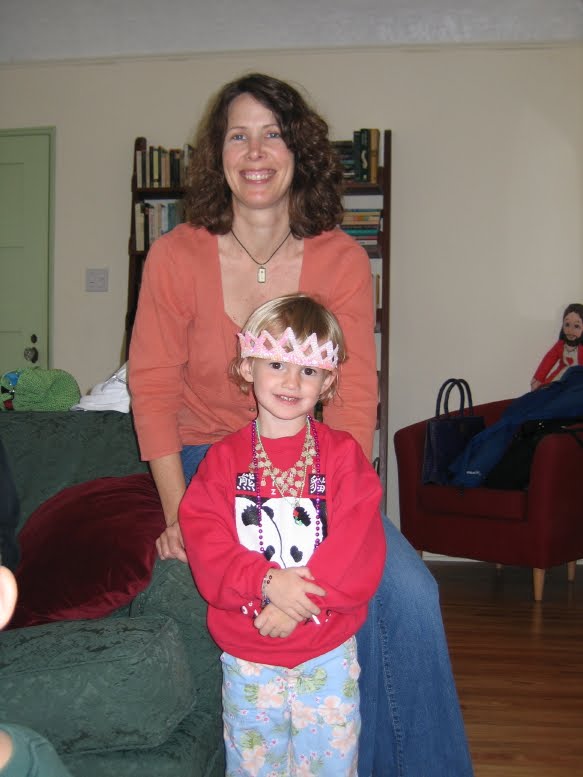
p.s. I was looking for a photo that illustrated the concept of happiness, and found this one of me with my niece a few years back. Really it's a cheap attempt to put up another photo of my adorable niece, since it has nothing to do with the Internet. But we do look happy.

May 5, 2010

Annie Leonard: hero or communist sympathizer?

Annie Leonard's video "The Story of Stuff," was the single strongest influence on me during my first year on The Compact (I'm almost halfway through my second already).

So I was happy to see her on The Colbert Report and learn that she'd written a book of the same name. The idea that we should all be aware of where our stuff comes from and try to move toward a more sustainable model for the future seems like common sense to me. But of course, it's a big threat to those who have a lot invested in our endless pursuit of buying more and more cheaply made throwaway products. And it turns out what she's doing is much more subversive than it appears at first glance.

She's an author, environmental activist, sustainability expert, and consumerist critic. And now her critics are calling her a lot of other things. Check out this article from the Denver Post about Leonard, called "Crusading for Mindful Consumption," and let us know what you think in the Comments section. Is she a positive force or a dangerous radical whose ideas would cause our economy to crater?

And if you haven't watched "The Story of Stuff," you can watch it here. And click here to see her on The Colbert Nation if you want a laugh with your news.

April 20, 2010

Why are you frugal, or semi-frugal, or resourceful?

The following is a reprint of a previously published post.

After I wrote yesterday's post "What do you splurge on?" it occurred to me that maybe I should have started with the question "Why are you frugal?" Because there's no point in being frugal for the sake of being frugal. There needs to be a reason, which ranges from sheer necessity (for example, you live on a fixed income or you're trying to support a family on minimum wage or you've been laid off from your job) to all manner of lifestyle goals and ideals.

One of my readers suggested that if I was uncomfortable with the term "frugal," perhaps I should substitute "resourceful." I like that. It brings to mind a sensible person, cheerfully making do with their circumstances. Creating a gourmet meal out of forgotten pantry items, making a cozy home in the wilderness, sewing stylish clothing out of burlap bags. Sort of a cross between Marmie from Little Women and MacGyver (ingenious uses for everyday items).

So WHY am I resourceful? There are many reasons, but they mostly revolve around wanting to create a lifestyle that meshes with my values and goals. The values have to do with non-consumerism and protecting the environment and trying not to use more than my fair share of the earth's resources. The goals involve wanting to work less, while at the same time doing work I enjoy and having control over my own schedule.

It all comes down to priorities. Mine have just never been to have a big house, an expensive car, lots of jewelry, or STUFF. They've always had more of an experiential element, and include doing work and activities I love, having time for my husband and friends, and not being tied down to a schedule. Also, living on less lets me feel more in control and less panicked if my husband or I get less work or if the economy takes a turn for the worse. Having money for an emergency and not living on credit means that we're not so dependent on jobs or the economy.

If I gave the impression yesterday that I was frugal just so I could spend money on travel, boots, and spas, that's not the case. I do splurge on some things, but they're not the overall point of a frugal or resourceful lifestyle. Joining The Compact was an extension of the way I was already living rather than a radical experiment, and I've realized that even more because nearly five months later, I've had hardly any challenges or temptations to wrestle with.

I'm not trying to recruit members for The Compact, but I guess in a way I AM trying to relate how simple it is to live on less. Maybe give a little hope to people who are doing it by necessity. How it can actually be creative, invigorating, and yes... fun! Because believe me, if you saw our lifestyle, I don't think anyone would call it deprived. Except for maybe someone like Donald Trump, who I would consider the exact opposite of me. It's hard to believe we're the same species, really. The only thing I can think of that we have in common is a thick head of hair. But then again, his is probably fake.

Why are you frugal, or semi-frugal, or resourceful? Or do you prefer another label entirely? Please tell us your thoughts in the Comments section.

February 3, 2010

Is it more expensive to be green?

There are a lot of misperceptions about being green and living sustainably, and one of the biggest is that it's expensive. Supposedly only the wealthy can afford to think about the environment.

But like a lot of conventional wisdom, it's just not true. In fact, a lot of "green" choices are frugal as well. Here are a just a few examples:

1. Local produce. According to the Natural Resources Defense Council, the average food item travels 1500 to 2500 miles to get to your supermarket, while local produce is usually grown within 200 miles. That saves transportation and fuel costs, along with all those carbon emissions. So the produce is usually less expensive and it almost always tastes better. Because of our CSA delivery experience, I can attest to that. Plus, many small local growers don't use pesticides or artificial ripeners, which keeps chemicals out of the soil.

2. Turning out the lights, using water-saving faucets and showerheads, and keeping the thermostat at a reasonable temperature are all energy savers that'll save you money as well.

3. Buying secondhand, borrowing, or bartering will not only reduce your carbon footprint, it'll plump up your bank account. So joining The Compact is certainly green, but it's definitely not expensive. And there's no sign-up fee!

Of course, buying "organic" produce at high-end markets and "eco-friendly" fashion can break your budget, but that's not the only way to be "green."

What "green" options have you incorporated into your lifestyle that are also frugal? I love it when they don't conflict and I don't have to choose one or the other. Please leave your examples in the Comments section.

December 30, 2009

Is there anything I'm dying to buy new in January?

Yesterday I explained that I would continue with the Compact and blogging about it into 2010, with some caveats. Today I'll answer this question from a reader: "Is there anything you plan on purchasing new in January? Something you've realized that you can't find used, or just really have been wanting to splurge on?"

Much to my surprise, there's nothing in particular that I've been waiting or planning to buy. But there are things that I know will present a challenge. My biggest concern with doing this project long-term is technology. I always use a computer and cell phone as long as possible, and I've even bought a refurbished laptop two or three times (I think all my laptops have been refurbished), but I'm not about to stop buying them entirely. And I have a feeling I'm going to want an iphone at some point, when the monthly service fees drop significantly. Since I'm not going to become a Luddite just because I'm a Compacter, I think the key will be to use items as long as possible and to dispose of them properly. So far I've always sold my old computers and returned used cell phones for recycling and I'm considering donating my old laptop.

Another thing that might not be easy to find used is personal items like sheets and towels. But when I do need those things, I'll look to other Compacters and my readers for suggestions. And I know there will be compromises, like if I absolutely need something and can't find it used. In that case I'll try to buy green and local. But I've also learned the value of borrowing or doing without. Those are underrated options. I've never owned a food processor and we have no room for one, but I still cook and bake a fair amount and borrow a friend's about once a year.

I am still "looking out for" a ceramic pot that sits out on the counter for food scraps on their way to the compost bin. I want it to look nice in our kitchen and haven't found anything in the thrift stores. That is something I may end up buying if I don't find one soon. And one other thing I really need is a digital camera. The one I've been using to take photos for this blog is really old and very temperamental and I spend way too much time coaxing it to behave. I am going to try to buy one used, perhaps on ebay. Let me know if you have any ideas about that.

And one other thing that came up recently...

A good friend is having a baby girl and the shower is in January. Oh, how I would love to go out and buy some beautiful baby clothes. Just yesterday I looked at an online children's clothing catalog and saw the most adorable little white fuzzy baby coat with a hood and lamb's ears. The company is all organic cotton and made in the USA, so I'm considering making an exception. But I would also really love to give them some of our favorite children's books, and I can probably find those used in good condition. What do you think, readers? I've done great so far with gifts, but do you have any ideas for baby gifts? I don't knit or quilt, and I want to give them something really nice. If you have any suggestions for non-consumer baby gifts, please leave them in the Comments section.

September 22, 2009

How do you judge success?

When I embarked on my experiment with nonconsumerism this year by joining The Compact, I assumed I would be successful. That is, I thought I would be successful at eschewing material comforts and making do with what I already had, with maybe a few slip-ups.

What I didn't realize was how much the whole endeavor would subtly work on my entire value system and worldview: what I care about, how I spend my time, and my definition of success.

I've been thinking about continuing with The Compact after this calendar year. That hadn't occurred to me when I started, but lately it seems very feasible. What's certain is that I'm not chomping at the bit, just waiting until I can go on a shopping binge come January 1st 2010. My Buy Nothing New commitment has changed me, because I've become aware of every purchase I make, and I could never go back to being an unconscious consumer.

And becoming conscious in this way has made me see more than ever how empty a value system that judges success based on material possessions really is. It's not that I didn't believe that before, it just wasn't quite as strong a conviction.

Sure, I like nice things. And having the bills paid and money in the bank helps us sleep at night. But once you're past that threshold of survival, does another pair of designer jeans really make you happy? A fancy car? A bigger house?

These questions aren't new or original, and each of us has to find our own answers, live our own lives, make our own discoveries. But I ask you: are people happier when they have more things, more possessions, more stuff? I've never seen any evidence of it. So why do so many people pursue that course so relentlessly? Sometimes I think we're a nation of people searching for salvation in a mall. Even some places of worship are turning into megachurches, mall-like entertainment centers that I can't begin to fathom.

And how do we buy all these things? We work more, to earn more money, to buy more stuff. I remember once back in the 1980s talking to a student from Germany. He couldn't understand why everyone was running around from one appointment to the next, their busy-ness an apparent measure of their success. He said that in Germany, people viewed success as having time to design their own schedules, and that included lots of coffee house lounging and intense conversation.

My idea of success squares more closely with this one than it does the materialist one. Lately I've been thinking that in our culture, the people we consider successful - namely because they make a lot of money - rarely have a moment to themselves. No time for introspection, goofing off, or just plain hanging out. They're slaves to their Blackberries. Maybe not at the level of Oprah or Bill Gates, but for many professionals who live in nice neighborhoods and drive Mercedes it's become the norm.

Certainly working at what you love, being good at it, and making a contribution in your field would constitute success. But that doesn't necessarily translate into material wealth. You could work for the Peace Corps, design a public space, be an excellent nurse, invent a labor-saving device, compose beautiful music, perform life-saving surgeries, write inspiring plays, discover a vaccine, or a million other things, and you may or may not be financially rewarded for it. It's nice if you are, but it doesn't prove whether or not you're successful.

My definition of success includes rewarding work (paid or unpaid), close relationships, an ability to appreciate and be grateful for what you have, having time to live an "examined" life and do the things you enjoy, achieving something you set out to do, doing a little extra when it will make a difference, and not always taking the easy way out. It would also involve a realization that you do make a difference, that we all do, and to resolve to work for what you know is good and right. To live your values. For me, successful people have made the world a better place.

In the end, I don't think anyone has said it better than Ralph Waldo Emerson:

"To laugh often and much; to win the respect of intelligent people and the affection of children; to earn the appreciation of honest critics and endure the betrayal of false friends; to appreciate beauty; to find the best in others; to leave the world a bit better, whether by a healthy child, a garden patch or a redeemed social condition; to know even one life has breathed easier because you have lived. This is to have succeeded."

How do you judge success? Please let us know in the Comments section.

September 2, 2009

Oldies but hopefully Goodies

I'm on vacation this week, but I thought I'd leave you with a few of my most popular blog posts of the past eight months. Unless you've been reading this blog all year, they're probably new to you. Here's one for each of the days I'll be gone:

Husband's Compact-y Birthday (wherein we discover we already have just what we need)

Continuous Small Treats (wherein I list my treats for a happy life, a la Iris Murdoch)

What do you splurge on? (wherein I delve into my boot obsession and more)

I'll be back next week with brand-new posts, including a CSA delivery on Monday, Thrifty Threads on Thursday, and Food Waste Friday.

Have a great Labor Day weekend!

August 23, 2009

Got 15 minutes?

This is a rerun of a previously published post. Reruns are great, right? Especially if you didn't see it the first time around. I'll be back tomorrow with a brand-new post.

Whether you're decluttering your house, trying to go green, save money, get organized, or all of the above, it's easy to get overwhelmed.

The key is baby steps. Divide your goals into small increments, and you can chip away at them until- tada! Before you know it, you'll have a whole closet organized, or the entire living room decluttered.

15 minute increments are just enough time to make a dent. You can start and complete one thing, or if you're on a roll, you can keep going. By working in 15 minute chunks of time, you can get a lot done.

In the book About a Boy by Nick Hornby, and then in the movie, the character played by Hugh Grant divided his day into 15 minute blocks. He did this because he lived off his father's money, didn't work, and had a lot of free time to fill. I don't know anyone who can relate to that, but I love the book and the movie, and I like the idea of the 15 minute increments, especially for trying to start projects that seem overwhelming.

So here are some of the things you can tackle in 15 minutes:

1. That stack of mail.
2. Your email inbox.
3. Online bills.
4. Your desktop.
5. Your computer desktop.
6. One drawer, one shelf, or one area in your home.
7. The refrigerator.
8. The pantry.
9. Your car.
10. A handwritten thank you note.

Here's how it's working for me: I have an index card on my bulletin board placed right where I see it all the time when I'm on the computer. It simply says "15 minutes" in block letters. I try to stop for 15 minutes once or twice a day, usually to go through mail or whittle down my inbox. Otherwise my time gets eaten up by the never-ending to-do lists, full of must-dos and short and long-term goals.

How do YOU accomplish your organizing and decluttering tasks and goals? Do you think the "15 minute system" could work for you? What tasks would you put on your "15 minute" list? Tell me your thoughts in the Comments section.

P.S. Since I wrote this, I found out that "the Fly Lady" is famous for her 15-minute philosophy. I wasn't forgetting to give her credit, I just hadn't heard of her.

August 19, 2009

What are you saving for?

What are you saving for?

Perhaps to be perfectly grammatically correct, the question should be, "For what are you saving?" In any case, the emphasis is on the for. Please forgive any dangling participles, if that's what it is.

I've just read Pride and Prejudice and Zombies, so I'm a bit more sensitive to abuses of the English language. If you're a Jane Austen fan, the book is hilarious. But I digress.

Although I haven't found my non-consumer lifestyle, and my previous nearly non-consumer lifestyle to be particularly difficult or full of deprivation, I think it's important to remember WHY we're living in this way, if it's by choice. For many people, a frugal lifestyle is not a choice but a necessity, because of limited income or extreme debt.

For those of you who live this lifestyle by choice, I'd love to know your reasons. Whether you're a non-consumer or a frugalista, or whether you proudly call yourself cheap, what are your reasons? Is it to lessen your carbon footprint, live a simpler and more meaningful life, not be a dupe to advertisers, or all of the above?

And if you're consciously trying to save, what are you saving for? A house? A car? A comfortable retirement? College for your kids or grandkids? A trip around the world?

My reasons for being frugal revolve around having the freedom to create my own life. I want to be able to do the work I love, and have time for things I care about, rather than essentially giving away my time in order to be paid a large salary to buy conveniences I need because I only have time to work. The vicious cycle of work and spend.

Now that I'm doing The Compact this year, I love that my choice is also helping me to create a simpler, more meaningful lifestyle on top of lessening my tread on the earth.

At this point, I'm not saving very much. It's more like I'm trying to learn to live on less so I don't need to earn as much. But what I do save is all about having the freedom to live the life I choose.

I love the idea of an ING account that lets you set up separate savings accounts for different goals: a vacation, college for your kids, retirement. Short term and long term mixed together in an organized fashion. I've always found that there is never any "extra" money for something, no matter how important it is. If you want to take that vacation, you have to start saving for it. And if you ever want to retire, you've got to start putting money away as soon as possible.

So, what are you saving for? I'd love to hear about it. What's your method for saving? Do you have an ING account or separate savings accounts for various goals? Please leave your thoughts in the Comments section.

July 20, 2009

Are you a non-consumer?

Are you a non-consumer? A conscious consumer? A Frugalista?

Or do you prefer another name, or no label at all?

Joining The Compact this year has made me somewhat of a non-consumer, but even that is relative since I still consume food, services like haircuts and an occasional pedicure, and dinners out. Also used items and wine. Oh, and I "consume" a weekly yoga class by paying the studio that runs it for the opportunity to be there.

I like the term conscious consumer, which implies a careful consideration of everything one purchases. Maybe you buy from a local bookstore instead of amazon, go to the Farmer's Market instead of the supermarket, or support a family-owned business rather than Wal-Mart. You make mindful purchases that support your values.

Another type is the Frugalista, who wants to live a fun and fabulous lifestyle, but without breaking the bank. A Frugalista, according to the Oxford University press, is "a person who lives a frugal lifestyle, but stays fashionable and healthy by swapping clothes, buying second-hand, growing own produce, etc." This type loves deals and freebies, and lives in a manner that bears no resemblance to deprivation.

Still others refer to themselves as frugal, thrifty, or resourceful. Some aren't ashamed to be called a cheapskate or a tightwad. They consider their habits a badge of honor, and think of themselves as smart.

This year I'm a non-consumer, and a bit of a Frugalista as well. If I'm frugal, it's to support a lifestyle where I can work less and by choice, and do things I love like travel and enjoy a nice dinner out. This article about a group of Maine residents for whom being frugal is nothing new was interesting. But a lifestyle that includes saving up for an Olive Garden dinner for your 50th anniversary 2 months in advance is frankly depressing to me. If you don't have the money, then that's fine. I'm not a believer in debt. But there are all kinds of stories of people who were stingy with their friends and relatives, not to mention themselves, their whole lives and left a pile of cash behind. I don't see that as anything to strive for.

I'm curious: how many of you are non-consumers or Compacters? Frugalistas? Are you unashamed to call yourself a tightwad? Or do you eschew labels altogether? Let me know in the Comments section.

June 23, 2009

20 Questions to ask your parents...

...or your grandparents, if they're still alive.

That's my dear grandmother in the photo. She died two years ago, but I know she wouldn't mind if I used this picture to demonstrate the unconditional love our parents and grandparents have for us.

Because they love us so much, we often don't know very much about them. Their focus is on us, and until we're adults, most of the time our focus is on ourselves.

I've been thinking about this question of what to ask your parents a lot lately, because I'm fortunate to still have both my parents alive and well. My husband lost his mother in his 20s and his father just before he turned 40. His mom died before he reached that sentimental stage when he might have started asking her what it was like to have 11 siblings, or why she didn't like cats.

Lately he wishes he could ask her why there was no music in their home, even though there's a photo of her playing the piano when his older sisters were very small, long before he was born. His father didn't enjoy music, so he never heard it during his childhood, he didn't even have a record player. But seeing that photo of his mom makes him want to ask her what kind of music she liked.

Here are some of the questions I've been asking my parents (and 91-year-old grandfather) lately. I've gotten some very interesting answers, and they seem to enjoy answering them:

1. What was your best ever family vacation?
2. Your favorite pet?
3. Your first love?
4. Your favorite teacher, and why?
5. Your best friend in grade school?
6. How did you meet (mom or dad)?
7. (If they were alive) what do you remember about VE Day?
8. (If they were alive) where were you when JFK was shot?
9. Do you remember watching the moon landing?
10. What's your favorite movie, and when did you first watch it?
11. Who's your favorite movie star?
12. What's your favorite song?
13. What's your favorite book, and when did you first read it?
14. Did you ever learn to play a musical instrument?
15. Did you ever win a trophy or award?
16. What was your first job, and do you remember your wage?
17. Do you remember the first TV program you ever watched?
18. Who's your favorite comedian?
19. What's your favorite childhood memory?
20. Who was your favorite president?

I like asking these questions as part of a conversation, but you can also ask them to write down their answers so you'll remember them. Another idea is to videotape them if they're not too self-conscious.

Most people love to answer questions about themselves and to reminisce. So go ahead, start asking questions. At the least, you'll learn something about your parent or grandparent you never knew before. You may come to understand them better, learn to love them in a different way, and strengthen the bond between you.

Do you ask your parents or grandparents about themselves? What interesting tidbits have you learned in the process? Tell us in the Comments section.

May 26, 2009

Why are you frugal, or semi-frugal, or resourceful?

After I wrote yesterday's post "What do you splurge on?" it occurred to me that maybe I should have started with the question "Why are you frugal?" Because there's no point in being frugal for the sake of being frugal. There needs to be a reason, which ranges from sheer necessity (for example, you live on a fixed income or you're trying to support a family on minimum wage or you've been laid off from your job) to all manner of lifestyle goals and ideals.

One of my readers suggested that if I was uncomfortable with the term "frugal," perhaps I should substitute "resourceful." I like that. It brings to mind a sensible person, cheerfully making do with their circumstances. Creating a gourmet meal out of forgotten pantry items, making a cozy home in the wilderness, sewing stylish clothing out of burlap bags. Sort of a cross between Marmie from Little Women and MacGyver (ingenious uses for everyday items).

So WHY am I resourceful? There are many reasons, but they mostly revolve around wanting to create a lifestyle that meshes with my values and goals. The values have to do with non-consumerism and protecting the environment and trying not to use more than my fair share of the earth's resources. The goals involve wanting to work less, while at the same time doing work I enjoy and having control over my own schedule.

It all comes down to priorities. Mine have just never been to have a big house, an expensive car, lots of jewelry, or STUFF. They've always had more of an experiential element, and include doing work and activities I love, having time for my husband and friends, and not being tied down to a schedule. Also, living on less lets me feel more in control and less panicked if my husband or I get less work or if the economy takes a turn for the worse. Having money for an emergency and not living on credit means that we're not so dependent on jobs or the economy.

If I gave the impression yesterday that I was frugal just so I could spend money on travel, boots, and spas, that's not the case. I do splurge on some things, but they're not the overall point of a frugal or resourceful lifestyle. Joining The Compact was an extension of the way I was already living rather than a radical experiment, and I've realized that even more because nearly five months later, I've had hardly any challenges or temptations to wrestle with.

I'm not trying to recruit members for The Compact, but I guess in a way I AM trying to relate how simple it is to live on less. Maybe give a little hope to people who are doing it by necessity. How it can actually be creative, invigorating, and yes... fun! Because believe me, if you saw our lifestyle, I don't think anyone would call it deprived. Except for maybe someone like Donald Trump, who I would consider the exact opposite of me. It's hard to believe we're the same species, really. The only thing I can think of that we have in common is a thick head of hair. But then again, his is probably fake.

Why are you frugal, or semi-frugal, or resourceful? Or do you prefer another label entirely? Please tell us your thoughts in the Comments section.

May 25, 2009

What do you splurge on?

I feel a confession coming on...

Since I joined The Compact and started writing this blog, I've learned so much about simple living and frugal living from visiting other blogs. But sometimes I feel a little hypocritical about associating myself with the frugal lifestyle, and I might hesitate in calling myself a Frugalista. I'm not really sure where I lie on the frugal/spendthrift continuum. Because there are some things I really splurge on (even while doing The Compact), they're just mostly not STUFF.

For example, I've read on several frugal blogs that they don't take vacations far from home. Well, travel is one of the passions of my life and I have always done without in order to have funds for my next adventure. When I finished graduate school, I sold my car so I could take a month-long train trip through England and Scotland. It was marvelous. And I never regretted getting rid of my pint-sized Toyota Tercel. It all worked out because when I came back from England, I moved to New York City, where I didn't need a car. I don't know if selling a car when you don't even own a stereo system and using it to fund a European vacation would be considered frugal, but it certainly highlighted my priorities.

Another example is my spa habit. I'm a real water-lover: I love swimming, snorkeling, kayaking, wading, floating, and taking long showers and baths. I find water very calming, and at the same time invigorating. So one of my big splurges is going to the spa for a facial and using all the facilities beforehand: the sauna, the jacuzzi, and the wetroom. I only do this 3 or 4 times a year, but it's not something I imagine some frugal lifestyle people would approve of. But for me, it's part therapy, part indulgence, part beauty routine, and I wouldn't give it up unless absolutely necessary. I'm also hoping those facials will save me money on skin care supplies in the future. Plus I rationalize this treat by reflecting on how spas and bathhouses are de rigueur in many parts of the world even for common folk, particularly in Asia and Eastern Europe.

I used to splurge on books and I honestly don't think that needs any rationalization because reading is such a huge part of my life. But for the past 3 or 4 years I've mostly been buying them used or going to the library. I will buy a new book occasionally, especially if it's by one of my favorite authors or I want to support a friend. But I still usually wait for the paperback.

Occasionally (pre-Compact) I'll splurge on a gift for a friend or my husband if I see the perfect thing that I just know they'll love. I don't feel pressured to spend a lot of money of gifts for anyone in my life, but I like to get a special treat now and then when it's something I know they'll particularly enjoy.

And I have been known to splurge on boots, because I've got a bit of a fixation, but I almost always find them on sale. This snazzy red pair in the photo, my current favorite, I bought on clearance for about $50. Their per-wear price will probably drop below a dollar eventually. But I won't be buying any new boots this year. And I bought those red boots at least two years ago.

So those are my favorite splurges. Does traveling or going to the spa mean I'm a spendthrift? Getting back to the question of where I would place myself on the frugal/spendthrift continuum, if California represented frugality and Maine stood for spendthrift (might make more sense the other way around), I would probably fall somewhere between Arizona and New Mexico. But maybe this analogy is getting too complicated...

I think of myself as fairly frugal, and I have usually done pretty well living on very little money, mostly out of necessity. I think my family would agree: I remember some family lore where one of my brothers bought something for me and the other brother commented, "Well, you know when you buy something for her, she keeps it forever." I think they were making fun of me a bit. I have one t-shirt that's so comfortable and perfect for hiking that I've been wearing it almost ten years and we can never date a photo because I'm wearing it in nearly every hiking picture. And I remember my mom visiting me once and noticing that I still used some towels about ten or twelve years after she and I had bought them together while shopping for my first apartment. She said something like, "Oh honey, you're so funny." But from my perspective, she's a real spendthrift. Who knows how many towels she'd gone through in that time.

So I think I'm fairly frugal, my family might think I'm extremely frugal (although not cheap because I've always given them nice gifts and I like to treat for meals and that type of thing), but I wonder what the frugal community would think of some of these expenditures. Would I have to hand in my membership card if they knew?

I'm trying to be honest about documenting my Buy Nothing New year, and this is something that's been on my mind lately. Even the name of my blog caused me some immediate regret, when I realized it would be more accurate to call it "My Year Without Buying," but it was really too late to change it at that point. The technical steps involved were beyond me, and I didn't want to confuse anyone.

Please write and tell me what you think of my splurges, and I would love to hear what you splurge on. You can leave your thoughts, questions, ideas and opinions in the Comments section. Part of my reason for not buying anything new is to have more money to save, and to spend on things I care about, like travel. And soaking in a hot tub. But I probably already have enough boots.

May 14, 2009

How do you measure wealth?

It's interesting that not buying things has made me focus more on what I DO have. And as I get rid of the crap, it's like lifting a curtain or coming out of a fog. I'm really starting to see how STUFF has kept me busy and distracted, and disconnected from the things that really matter.

Because even though I'm trying to live on less income, not buying anything new, and getting rid of things I no longer need or use, instead of feeling deprived, I'm feeling rich.

I'm rich in love and friendships.

I'm rich in health and well-being.

I'm rich in time to design my own schedule.

Some of my wealth is a little more tangible, and adds to my level of happiness. For example, we planted a lemon tree last weekend, and when it starts producing fruit, we'll be rich in lemons. And I'm already rich in citrus because along my walking route I have asked and been given permission to pick as much grapefruit as I like from one neighbor and as many kumquats as I want from another. They both seemed happy to be able to share their bounty.

This recession is making people question a lot about their values, lifestyles, and behavior. I think it will have a silver lining if it makes us question our relationship to the planet and the other people living on it. And if it causes us to use a different yardstick to determine how we feel about ourselves.

So how can we measure wealth? Does it only refer to our bank account? Or is it about other intangibles like love, happiness, friendship, health, and time?

How do YOU measure wealth? Please leave your thoughts in the Comments section.

April 1, 2009

To Declutter or Not To Declutter

I've declared 2009 not just a year of Buying Nothing New by joining The Compact, but also a year of Decluttering. Actually, I thought I'd declutter in January and that would be that. On February 1st, I realized it might take a bit longer. Now, on April 1st, I think I'll be lucky if I get through it in a year.

I'm actually excited about the idea of ridding my life of all extraneous STUFF. It's taking up space, in my home and in my psyche. And I joined Non Consumer Girl in her goal of making an extra $5000 by selling things she no longer needs or uses on ebay. That made me even more excited, although my husband made a snide remark about that figure being unrealistic (he might have said crazy). Actually, he probably said unrealistic, but I heard crazy.

Anyway, the 5000 bucks really got me excited. Now I'm even more psyched to get rid of stuff. And yet. Stuff still here. Stuff not leaving the house. What could be going on?

I'm a little worried I have a bit of a hoarder in me. I'm not proud of it. In fact, it scares the hell out of me. I have seen the results of hoarding in more old relatives than I care to count. It's pathological. It's illogical. It's germy.

So I know I don't want to become the lady with 87 cats or the old man with stacks of old newspapers blocking the path to the bathroom, but what's keeping me from getting rid of some things I no longer use?

Part of it is sentimentality. I have a lot of old clothes and books and toys from when I was young that I can't part with. I've heard "organization and declutter experts" say to take a photo of the item and get rid of it, because things aren't memories. True. And yet...

I think it comes down to fear. Fear of getting rid of something I'll regret. What if I give it away and then wish I hadn't? The funny part is that I can only think of ONE THING in my whole life that I later wished I hadn't gotten rid of. And it was just a shirt that I thought about later and wondered why I'd sold it at a garage sale for a dollar. A shirt.

So, I really should take my chances. There's really no choice here. It's not as if I'm going to forget my senses and suddenly throw my favorite piece of jewelry - my great aunt's onyx ring - into the recycling bin. I'll keep all the photos, old letters, and old journals. But I can give up the Mickey Mouse alarm clock.

There are all kinds of tricks and rules for decluttering: start with one drawer, get rid of any item of clothing you haven't worn for a year, etc. The best and easiest method I've found is on FruWiki, a great website about living frugally, reducing waste, and saving money. Click here for their decluttering tips. I'm going to start using them... very soon.

What about you? Are you fearful of decluttering, or do you love it? Have you ever gotten rid of something and regretted it? Please share your thoughts in the Comments section.

March 30, 2009

How much do you need to live on?

How much each of us needs to live on determines a lot of the choices we make in life. And I would argue that how much we THINK we need to live on determines them even more.

Which brings up an interesting paradox in this economy: the more money you make (and think you need to live on), the more worried you probably are. I'd be terrified if I had a 200K job. Your eggs are all in one basket, so to speak, and you've probably come to believe you NEED that much to survive.

While since I'm used to working freelance, I never know how much I'm going to bring in. My husband does this as well, so the effect has been that we always live on LESS than we usually make, in case both of us aren't bringing in very much. But the irony is that my hodge podge collection of little jobs not only has trained me to live on less, it's actually a better bet in this market not to just rely on one job.

Of course most people still work for one employer at one job, and for most people that's convenient and works out the best for them. And that's great. But I would still argue that even for people who know exactly how much they're bringing in, it would be smart to think about how much you really NEED to live on. If you live below your means, you'll not only save more for retirement and things that are important to you, but you'll be more prepared if you face an unexpected layoff or illness in the family.

The interesting thing is that most people tend to adjust to whatever their income is. So if you make $50,000 and you get a raise to $60,000, you probably won't have $10,000 minus taxes in savings at the end of the year, you'll most likely have spent it.

And whether you make $20,000 or $100,000 or $250,000, my guess is that that's the amount you truly believe you NEED to live on. I live in Los Angeles, and a lot of my friends work in the film industry. It's very common to make six figure salaries, even for trade/craft type jobs. So most people have come to believe they can't possibly live on less than $100,000 a year. If you ask them how they think other people live on the average of $42,000, they'll say it's not possible in Los Angeles. It's true that rents and mortgages are more than you would pay in places like the midwest, but we own our home and I certainly don't believe I HAVE to make at least $100,000 or I'll never survive.

Here's an example of what I'm talking about. If you drive a BMW, and it needs a new tire, that might cost you $450. I drive a Camry, and as far as I'm concerned it's like driving a luxury vehicle, but when I replace the tires all four will cost less than that. So the CHOICE of driving a BMW puts you in the position of needing more money to live on. As do all kinds of other CHOICES about what neighborhood you live in, how big your house needs to be, how often you must eat out, where your children must attend school ($15,000 a year for some preschools, and I'm not exaggerating for effect), and what car you drive.

All of this is pretty obvious. But I think a lot of our choices are unconscious, because a lot of what we do is determined by the culture we live in. And I mean the culture of our friends and neighborhood and the work we do, in addition to the general consumer culture. It's the soup we swim in. If we earn $250,000, we don't have the slightest idea how someone lives on $42,000, and we probably feel sorry for the poor schlub, if we think of them at all.

For me, whenever I've earned the most money, I've been the most unhappy, because I'm working way too hard. I spend too much on everything because I don't have time to cook or make wise purchasing decisions. When I save more and spend less, I feel more free and more in control. I don't have to worry if I get less work, because I don't need as much money in the first place.

I hope you love the work you do. I'm not anti-work. I think work can be an important part of life and something that offers great rewards. But working for the sake of making more money to buy more stuff is a no-win situation that will end up costing you more than you can afford.

A lot of people are waking up to the trap of our consumer culture. If you've never seen The Story of Stuff, check it out. It's a great argument about how STUFF is destroying us- working for stuff, buying stuff, throwing out stuff. It's destroying our neighborhoods, our communities, our health, and our environment.

So what are YOUR assumptions and expectations about how much money you need to live on? Would you like to be able to live on less? Please share your thoughts in the Comments section.

February 25, 2009

Stay married and save the planet?

I couldn't help noticing that provocative news headline yesterday. So how does being married help save the planet? According to Senator Steve Fielding from Australia, staying married is better for the planet because newly single people lead more wasteful lifestyles, so divorce makes climate change worse. He says that when people separate they need more space, more electricity, and more water, and that increases their carbon footprint. He says this proves that divorce isn't just a social problem, but an environmental one. According to Fielding, married couples live a more "resource-efficient lifestyle."

Fielding made his remarks at an Australian Senate hearing on environmental issues. I think there are some problems with his assumptions. I'm skeptical of his research and opinion because he's the leader of the independent Family First party and grew up in a family of 16 children. In my experience, at least here in the states, any group with the word "family" in the title is sort of code for "anti-gay, anti-feminist, anti-liberal." Also even though I'm married, I was single for many years prior to moving in with my then-boyfriend, and I have lots of single friends. Blaming them for global warming seems beyond ridiculous. Further, there's the emphasis on marriage, when clearly his resource-efficiency argument would work just as well for couples who are living together. And finally, I love children, but surely married couples with children are leaving a larger carbon footprint than any singletons out there.

But he does have a small point, and that is that it's a fact that two can live cheaper, and therefore more efficiently, than one. I just don't think we have to bash singles to make that point. What do you think? Whether you're married or single, chime in with your opinion on how married couples or singles hurt or harm the climate crisis.

February 1, 2009

Am I unpatriotic?

George Bush infamously asked Americans to go shopping to show their patriotism and jumpstart the economy after 9/11. This morning the AP ran a story titled "Americans save just when economy needs their money." And I have been thinking about this whole question of how economies work and whether I'm going to be contributing to the problem. But it's not an easy questi0n to answer without getting an economics degree. Wait, I do have an economics degree, from way back in 1984, but I don't remember much about it. I wasn't really that interested in it even at the time.

The AP article says American's new frugality couldn't be happening at a worse time. They cite the "paradox of thrift": that what's good for individuals - spending less and saving more - is bad for the economy when everyone does it. But the article continues by quoting economists who say the amount of spending of the past two decades was unsustainable, fueled only by gains in home equity, which was an illusion.

My first thought is that we Americans operate in extremes. We've heard for decades that we don't save enough, and we're drowning in debt. I suppose now if everyone really started saving half their paycheck and not frequenting their local shops and restaurants, that might not be the best thing to get the economy back on track. But that's not going to happen. Wouldn't it be better if more people started saving for an emergency and not buying things they don't need on credit?

There's also the issue of short term versus long term. In the short term, the economy needs to get back on track and maybe we as consumers need to help out with that. But in the long term, we really need to focus on these issues of climate change and environmental damage and how we contribute to the problem with materialism and overconsumption. So I think that long term goal is even more important than the short term goal of fixing the current economic crisis. And I put the burden of that job more heavily on government, banks, and corporations, than I do on myself or consumers.

Finally, just because I'm not going to buy any Gap clothes or Pottery Barn accessories this year, it doesn't mean I'm not going to be contributing to the economy. For one thing, I still have to buy food and I'll still be going out to eat. And we're not giving up wine and beer, so Trader Joe's will be getting just as much of our business. Also, there are plenty of services I'll still be using- I see no reason to give up getting a haircut or going to the car wash occasionally. Going to the car wash uses much less water than doing it in your driveway. So in a way, the title of my blog is misleading. I'll still be spending, just not buying new stuff.

But this is an ongoing question I'll be exploring. My hunch is that the economy would do just fine if everyone cut back and saved responsibly and didn't go into debt. It's the Wall Street bandits and corporations that have been making huge profits that might feel it if people stop buying cashmere mittens and designer kittens. So I say not buying all their crap IS patriotic!

What do you think? Can the economy get back on track if people stop buying new stuff?